The Towndrow Genealogy Website
| Home |
| Our Roots |
| Family Tree |
| Archive |
| Fame |
| Sydney 2007 |
| Malvern 2005 |
| Niagara 2002 |
| Matlock 2000 |
| Raton 1998 |
| Contact Us |
| Resources |
| DNA Survey |
| Towndrow.Net |
Our Roots |
||||
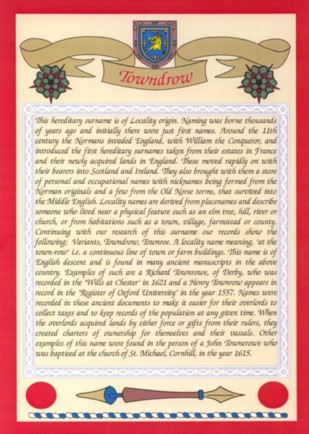
Our earliest record of the Towndrow name is before 1650. Before that, we get mired down in variations on the name, which makes it so much harder to trace back. Theoretically though, we can trace how the surname became first 'mutated' from a Townrow, Townrowe, Townerow, Townroe, Tounrow, Towndro or Towndroe, many of which are listed as residents in what is now Derbyshire/Leicestershire/Nottinghamshire/Yorkshire in the earlier 1600s and beyond. Our first cast-iron point of reference - or points - are two Benjamins: Benjamin Towndrow (b. 1704) married Dorothy Bunting, again in Derbyshire, and ten children from 1725 onwards. Their son Edward moved to Bedfordshire with his wife and begat Benjamin, who in turn married and had a son Benjamin. This Benjamin emigrated to Australia in the 1840s, married, and effectively established the Towndrow line 'down under'. Another notable point about this lineage is the brothers James and John Henry who emigrated from Derbyshire in the late 1800s to the USA and are the ancestors of many of the Towndrows currently residing in the US and Canada. The second Benjamin Towndrow (b. Ashover, Derbyshire, May 21 1684) married Anne Grannah and had nine children. Six or more children at the time was not uncommon and the large families over the next couple of centuries, and the relatively limited number of forenames, can make tracing lineage difficult. We do know that Benjamin was the son of John Towndrow b1668, who was in turn the son of Richard Towndrow, but the details of these individuals are not complete. It is interesting to note that whilst the origin of both branches is around the same point in history, the differing marriage and offspring patterns of the two Benjamins' legacy means that Benjamin & Dorothy's descendants outnumber Benjamin & Anne's by about 10 to 1 ! What we would really like to do is identify a common ancestor of these two branches and thus unify the family tree. Almost every Towndrow we know of fits into one of these branches [affectionately known as the 'rich' and 'poor' sides of the family - the Grannah and Bunting branches respectively - after their descendants' relative wealth and differing occupations]. To unite the branches, research in the 1500-1600s continues but we have also embarked on a DNA project to prove a biological link - even if the historical records themselves remain elusive. Read more on the Family Tree page. Origin of the Towndrow Name "I was led to believe that an architect designed London city dwellings following the Black Death. The housing had each floor wider than the one below it, reason being the prevention of night soil from running down the building. This, coupled with new open flowing sewers running down the middle of the road, led to improved sanitary conditions whilst at the same time increasing density of occupancy. The architect responsible for this was knighted Sir Townsrow or Town Row. BUT the fire in Pudding Lane some years later caused devastation due to a fundamental design error. Because the roofs got closer with each successive floor that was added, after many decades the rooftops touched, causing the rapid spread of the Great Fire. Shortly afterwards, the family changed its name to Towndrow to avoid notoriety." from Steve Towndrow of Manchester This has also been found : TOWNDROW (British). "Town row" (i.e. street). For more, see the full research result here >> origin
The Towndrow Coat Of Arms |